Medical Affairs is taking on an increasingly strategic role within biopharma. The function is expected to generate and translate evidence, engage scientific stakeholders, operationalize medical insights, demonstrate impact, and make better use of data, analytics and digital capabilities.

At the same time, organizations are investing in medical insight platforms, analytics, AI, digital engagement, and workflow automation. Yet technology alone does not transform how Medical Affairs operates.
If roles remain unclear, processes fragmented, data inconsistent and decision rights undefined, technology can simply digitize existing inefficiencies. Before making significant transformation investments, organizations need to understand whether their operating model is ready to support them.
A Medical Affairs Operating Model Assessment provides that foundation.
Why Medical Affairs Transformations Struggle
Medical Affairs operates across global, regional and local teams and multiple capabilities, including Field Medical, Medical Information, Scientific Communications, Evidence Generation, HEOR/RWE, Medical Insights and Medical Operations.
As these capabilities evolve, organizations can develop:
Transformation programs often attempt to solve these problems by implementing a new platform, automating workflows or introducing AI.
But the more important question comes first: Is the organization ready to operate differently? Without answering this, organizations risk investing in new capabilities without achieving the expected improvement in performance.
What an Operating Model Assessment Should Establish
An Operating Model Assessment goes beyond reviewing organizational structure or assigning maturity scores. It examines whether the capabilities, organization, processes, data and technology required to execute Medical Affairs strategy work together effectively.
It should answer five fundamental questions:
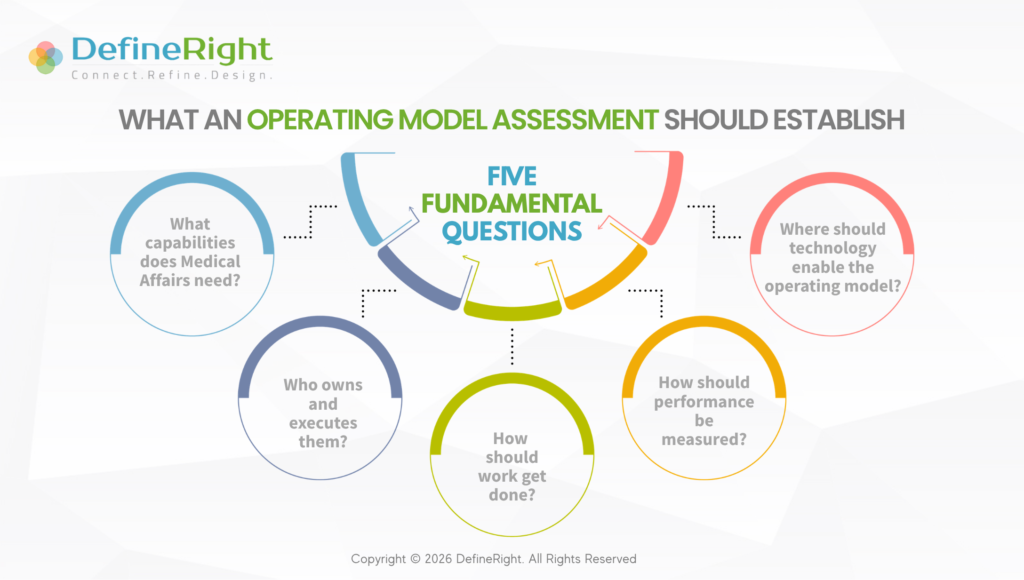
These questions provide a structured basis for designing transformation.
Five Building Blocks of a Medical Affairs Operating Model Assessment
1. Strategy and Capabilities
The assessment should start with Medical Affairs strategy not technology. Organizations need to determine which capabilities are required to deliver their strategic priorities and how mature those capabilities are today.
This includes understanding:
- Required future-state capabilities
- Current capability maturity
- Critical capability gaps
- Global versus local requirements
- Opportunities for analytics, digital and AI enablement
The result is a capability map connecting strategic priorities with operational requirements. Without this foundation, transformation can become a collection of disconnected initiatives rather than a coordinated change program.
2. Organization, Ownership and Processes
Transformation frequently introduces new responsibilities without establishing clear accountability. An assessment should therefore clarify:
- Roles and responsibilities
- Process ownership
- Global, regional and local ownership
- Cross-functional interfaces
- Governance and decision rights
- Key handoffs between teams
It should also identify where similar workflows have evolved differently across therapeutic areas or geographies. Processes such as medical insight intake, scientific content review, medical Information workflows and evidence-generation tracking can then be standardized, simplified, automated or eliminated where appropriate.
The objective is not necessarily centralization. Centralized, decentralized and hybrid models can all work. The objective is clarity, consistency and accountability.
3. Data, KPIs and Performance Measurement
Medical Affairs is increasingly expected to demonstrate impact rather than only activity. Measures such as HCP interactions, medical inquiries and congress engagements remain useful, but they do not necessarily demonstrate progress against strategic objectives.
Organizations therefore need a stronger performance foundation covering:
- Consistent KPI definitions
- Data ownership
- Reporting standards
- Data integration
- Analytics capabilities
- Performance governance
An assessment identifies where inconsistent data, disconnected reporting or poorly defined metrics limit visibility and decision-making. Without these foundations, transformation may produce more dashboards without producing better insights.
4. Technology and Digital Enablement
Technology decisions should follow operating-model decisions. Once capabilities, processes, ownership and data requirements are understood, organizations can evaluate where technology can create meaningful value.
The assessment should examine:
- Existing platforms and functional gaps
- System integrations
- Manual workflows
- User experience and adoption barriers
- Automation opportunities
- Analytics requirements
- Potential AI use cases
This changes the transformation question from “What technology should we implement?” to “What capabilities and processes should technology enable?”
5. Talent, Readiness and Transformation Roadmap
A future-state operating model may require capabilities that do not exist at a sufficient scale today, including data literacy, analytics, digital engagement, insight synthesis, AI-enabled workflows and change management.
The assessment should identify which capabilities need to be built internally, sourced externally or enabled through technology. These findings should then translate into a prioritized transformation roadmap based on:
This ensures organizations address foundational gaps before implementing more advanced capabilities.
How the Assessment Reduces Transformation Risk
A structured Operating Model Assessment reduces risk before transformation begins by:
- Establishing a fact base: Creating a shared view of current capabilities, maturity and pain points.
- Exposing dependencies: Identifying process, governance, organizational and data changes required before technology implementation.
- Improving prioritization: Separating high-value capability gaps from lower-priority improvements.
- Clarifying accountability: Establishing ownership, governance and decision rights.
- Aligning business and technology: Connecting technology investments to defined capabilities and outcomes.
- Creating a realistic roadmap: Sequencing initiatives based on value, readiness and dependencies.
The result is not simply an assessment score. It is a more informed and lower-risk transformation plan.
How DefineRight Helps
DefineRight helps Medical Affairs organizations establish the foundation for successful transformation through:
Combined with capabilities across business discovery, process improvement, data and analytics, and digital solutions, DefineRight can connect assessment with execution: from understanding current-state gaps to defining and operationalizing the future state.