
Clinical development has become significantly more complex over the past decade. Studies are increasingly global, protocols are becoming more sophisticated, regulatory requirements continue to evolve, and organizations are expected to deliver faster without proportionately increasing operational costs.

At the same time, clinical portfolios are expanding. Organizations are managing multiple studies across different therapeutic areas, phases, and geographies while coordinating work across dozens of cross-functional teams. In this environment, people are among the most valuable assets. Ensuring the right resources are available at the right time directly influences study timelines, operational efficiency, portfolio performance, and ultimately the speed at which new therapies reach patients.
Yet despite its strategic importance, in many organizations, resource planning is spread across enterprise systems, departmental tools, and spreadsheets. While Clinical Trial Management System ( CTMS ) platforms effectively manage study execution, spreadsheets often continue to support capacity planning, what-if analysis, and cross-functional forecasting.
As clinical portfolios continue to grow, resource capacity planning must evolve from a manual administrative activity into a strategic capability that enables informed, proactive decision-making.
Understanding Resource Planning in Clinical Development
Resource planning in Clinical Development is far more complex than assigning individuals to projects. Every clinical study requires coordinated execution across multiple specialized functions, each with different responsibilities, timelines, and workload patterns.
Clinical Operations – Executing the Study
Clinical Operations is responsible for executing clinical trials from study startup through close-out.
Typical responsibilities include:
- Site selection and activation
- Investigator and site management
- Patient recruitment and enrollment
- Clinical monitoring
- Vendor management
- Study execution
- Study close-out
Unlike many operational functions, workload within Clinical Operations changes continuously. Patient enrollment may accelerate unexpectedly, protocol amendments can increase monitoring requirements, additional sites may need activation, or regulatory changes may alter study priorities. Resource demand therefore fluctuates throughout the lifecycle of every study.
Development Operations – Managing the Portfolio
While Clinical Operations focuses on executing individual studies, Development Operations focuses on managing the broader clinical development portfolio.
Its responsibilities typically include:
- Portfolio planning and governance
- Cross-functional resource planning
- Capacity forecasting
- Program and project management
- Milestone tracking
- Executive reporting
- Budget and timeline governance
Development Operations must continuously balance demand across Clinical Operations, Data Management, Biostatistics, Medical Monitoring, Medical Writing, Regulatory Affairs, Project Management, and other specialist teams. Rather than optimizing a single study, the objective is to optimize the entire portfolio while ensuring that critical programs receive the resources they need.
The Challenge: Why Spreadsheet-Based Forecasting Falls Short
Spreadsheets remain the default planning tool for many organizations because they are familiar, flexible, and inexpensive. However, as clinical portfolios become larger and more interconnected, their limitations become increasingly evident.
Limited Portfolio Visibility
Resource planning is often performed independently by study teams, functional leaders, PMOs, and finance teams. Each group maintains its own forecasts, assumptions, and planning models, creating multiple versions of the truth.
Without a consolidated view across the portfolio, leadership struggles to answer fundamental questions:
- Which studies are competing for the same resources?
- Which functions will reach capacity over the next quarter?
- Can another Phase III study begin without delaying existing programs?
- Where are future bottlenecks likely to emerge?
Static Plans in a Dynamic Environment
Clinical development rarely follows the original project plan. Enrollment may exceed expectations, protocol amendments may alter workload, sites may activate later than expected, new studies begin while others are delayed, and so on.
Spreadsheets capture only a snapshot in time. By the time updates are consolidated and shared, priorities have often changed again.
Fragmented Operational Data
Critical planning information is typically spread across multiple systems.
Portfolio plans may reside within project management platforms, study execution information within CTMS systems, clinical data within EDC platforms, workforce data within HR systems, while actual resource forecasts continue to reside in spreadsheets.
The absence of a unified operational view makes informed decision-making difficult and significantly increases manual effort.
Reactive Rather Than Proactive Planning
Without visibility into future demand, organizations often discover resource constraints only after they begin affecting study timelines.
Instead of anticipating future capacity shortages, teams spend valuable time reacting to operational issues that could have been identified much earlier.
Resource Planning Requirements Change Throughout the Clinical Development Lifecycle
One of the primary reasons spreadsheet-based planning becomes ineffective is that resource demand is not constant. Every stage of a clinical study requires different skills, different levels of effort, and different functional teams. As studies progress, and particularly when timelines change unexpectedly, resource requirements shift continuously across the organization.
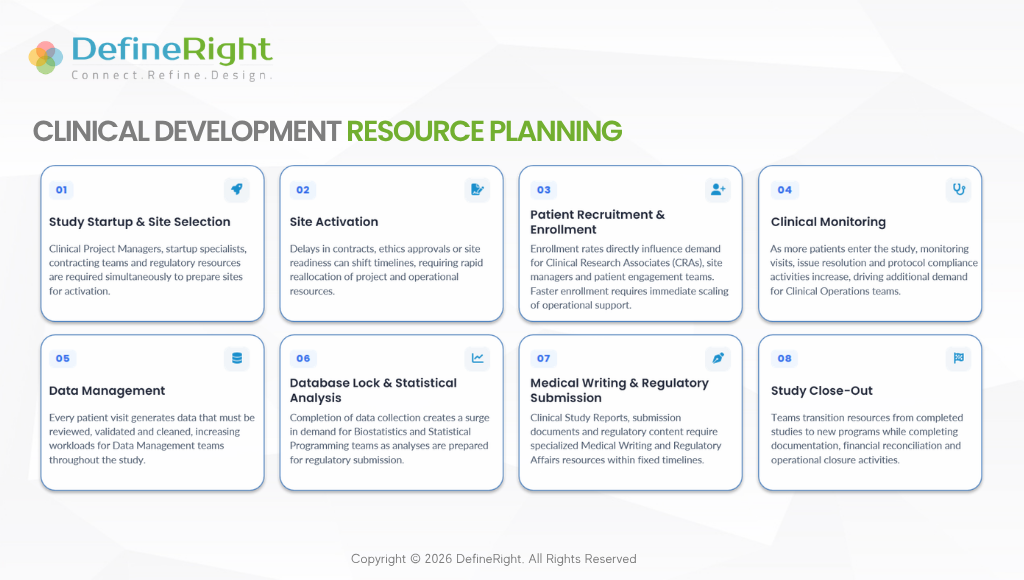
Development Operations leaders need continuous visibility into future resource demand—not only within individual studies, but across the entire portfolio.
Moving Towards Modern Resource Capacity Planning
Leading life sciences organizations are replacing spreadsheet-based planning with integrated resource capacity management capabilities that combine standardized processes, portfolio governance, operational data, and intelligent decision support.
Key characteristics include:
Portfolio-Level Visibility
Rather than viewing studies independently, organizations gain a consolidated view of resource demand, portfolio health, milestone progress, and operational risks across all ongoing programs.
Continuous Capacity Forecasting
Resource forecasts evolve as portfolio priorities change. Timeline changes, enrollment fluctuations, staffing updates, and strategic decisions are immediately reflected in future capacity projections.
Scenario Planning
Organizations can model different scenarios before making operational decisions.
For example:
- What happens if enrollment accelerates?
- Can another oncology study begin next quarter?
- Which functions become bottlenecks if timelines overlap?
- Should additional hiring begin now?
Scenario planning transforms resource management from reactive scheduling into proactive planning.
Standardized Governance
Successful organizations establish common planning assumptions, standardized resource definitions, governance frameworks, reporting standards, and clearly defined ownership across functions.
This improves consistency while reducing the effort required to prepare governance reviews and executive reports.
Integrated Operational Data
Bringing together portfolio, workforce, study execution and operational information creates a single source of truth for planning.
Integrated data enables leaders to understand resource demand, utilization, allocation, delivery risk, and portfolio performance without manually reconciling multiple reports.
Better User Experience Improves Adoption
One challenge that is often overlooked is user experience.
Many resource planning processes involve navigating multiple spreadsheets, copying information between files, manually consolidating reports, and updating the same information in multiple places. These repetitive tasks consume valuable time and discourage regular updates.
Modern planning solutions place equal emphasis on usability. Intuitive interfaces, role-based dashboards, guided workflows, and automated synchronization make it easier for project managers, functional leaders, and executives to contribute to and consume planning information.
Better user experience drives greater adoption, more timely updates, improved data quality, and ultimately more reliable resource forecasts.
Business Benefits
Organizations that modernize resource capacity planning realize benefits that extend well beyond improved forecasting.
Better Portfolio Governance
Leadership gains greater visibility into portfolio health, enabling stronger governance, improved prioritization, and more informed investment decisions.
Improved Resource Utilization
Enterprise-wide visibility enables organizations to balance workloads more effectively, reducing both overallocation and underutilization across specialist teams.
Greater Delivery Predictability
Capacity constraints become visible before they affect critical milestones, enabling proactive intervention and reducing execution risk.
Faster Executive Decision-Making
Standardized reporting and integrated operational data reduce manual reconciliation and enable leaders to focus on strategic decisions rather than validating spreadsheets.
Reduced Administrative Effort
Automation and standardized planning significantly reduce the time spent updating spreadsheets, preparing governance packs, and producing executive reports.
Scalable Clinical Operations
As organizations expand their clinical portfolios, modern resource planning provides the operational foundation needed to scale efficiently while maintaining governance and execution excellence.
Conclusion
Resource capacity planning has evolved from an operational reporting activity into a strategic capability for clinical development organizations.
Organizations that continue to rely on spreadsheet-based forecasting often struggle with fragmented information, limited portfolio visibility, reactive decision-making, and increasing administrative effort. As portfolios grow in size and complexity, these challenges become even more pronounced.
Modern resource planning is about much more than forecasting headcount. It requires portfolio-wide visibility, standardized governance, integrated operational data, intuitive user experiences, and the ability to continuously adapt as studies and priorities evolve.
At DefineRight, we help life sciences organizations strengthen operational execution by combining domain expertise, process transformation, and digital solutions enabling organizations turn planning into predictable execution.