Artificial Intelligence has become the centrepiece of commercial transformation across the life sciences industry. Pharmaceutical and biotech organizations are investing heavily in AI-powered forecasting, next-best-action engines, customer engagement platforms, sales analytics and decision support systems.

Yet many of these initiatives fail to deliver meaningful business value, not because the AI models are inadequate, but because the commercial data ecosystem feeding them is fragmented, inconsistent and poorly governed.
Organizations often believe that buying an AI platform will solve reporting, forecasting and decision-making challenges. In reality, AI simply amplifies the strengths, or weaknesses, of the underlying data foundation.
Before investing in advanced analytics or AI, commercial organizations should first establish a clear commercial data strategy that aligns data investments with business objectives.
Why Commercial AI Initiatives Struggle
Commercial teams today have access to more information than ever before:
- Customer Relationship Management (CRM) and customer engagement data
- Sales performance data
- Territory and account information
- Third-party prescription and claims data
- Market access information
- Marketing engagement metrics
- Pricing and contracting data
- Financial performance metrics
The challenge is rarely a lack of data. The challenge is that these data assets typically evolve independently, resulting in:
· Lack of standardized Key Performance Indicators (KPIs) and business metrics
· Weak data governance and unclear ownership
· Poor data quality and reliability
· Fragmented data landscape and duplicate data pipelines
· Delayed reporting and slower decision-making
· Inconsistent insights across commercial functions
When AI models are built on this foundation, organizations simply scale inconsistent decision-making.
The Real Objective Is Better Commercial Decisions
A commercial data strategy is not just a technology program, it’s a business-critical initiative for enabling better decisions. It should not start with choice of tools and technologies, instead it should focus on the information and decision needs of the organization
Commercial leaders should think about:
- Which decisions do we want to improve?
- What information is required to support those decisions?
- Which KPIs truly drive commercial performance?
- Which data sources are currently trusted and reliable?
- Where do gaps exist today?
- Who owns the quality of commercial data?
- What are the stated concerns about timeliness of data driven insights?
Only after these questions are answered does AI become an accelerator rather than an experiment.
Five Building Blocks of a Strong Commercial Data Strategy
1. Start with Business Outcomes
The most successful organizations begin with business priorities, not technology.
Typical objectives include:
- Improving territory performance
- Increasing forecast accuracy
- Optimizing HCP targeting
- Enhancing launch readiness
- Improving commercial resource allocation
- Measuring marketing effectiveness
- Improving market access visibility
Every data initiative should map directly to one or more measurable business outcomes. At DefineRight, business discovery workshops focus on understanding operational priorities before recommending data or technology investments. This ensures analytics initiatives remain aligned with commercial objectives rather than becoming isolated technical projects.
2. Establish Trusted Data Foundations
Many commercial organizations underestimate the effort required before analytics can generate reliable insights.
Core foundational capabilities include:
- Common KPI definitions
- Standardized master data
- Product and customer hierarchies
- Metadata standards
- Data quality controls
- Data ownership
- Governance processes
Without these fundamentals, dashboards frequently produce conflicting numbers, reducing confidence among business users. Strong governance creates the “single source of truth” required for scalable analytics. DefineRight identifies fragmented commercial data, manual reporting and lack of trusted metrics as common challenges that data foundations and governance are designed to address.
3. Understand the Entire Commercial Data Landscape
Commercial data rarely resides in one system. Organizations typically depend on:
- Salesforce CRM
- Enterprise Resource Planning (ERP) platforms
- Customer master systems
- Third-party market data
- Pricing and contracting applications
- Marketing automation platforms
- Data warehouses
- Finance systems
Before introducing AI, organizations should document:
- Where data originates
- How it flows
- Which systems own specific information
- Existing integrations
- Reporting dependencies
- Current pain points
This prevents duplicate investments and identifies opportunities for rationalization.
4. Build Governance Before Dashboards
Many organizations prioritize dashboard development while delaying governance. This creates attractive visualizations using the best of tools, that quickly lose credibility.
Effective governance should define:
- KPI ownership
- Data stewardship
- Change management processes
- Reporting standards
- Prioritization mechanisms
- Decision rights
Governance enables analytics to scale consistently as commercial organizations grow.
5. Develop an Analytics Roadmap
Not every analytics capability needs to be implemented simultaneously. A phased roadmap allows organizations to generate value early while building long-term capability.
A typical maturity journey includes:
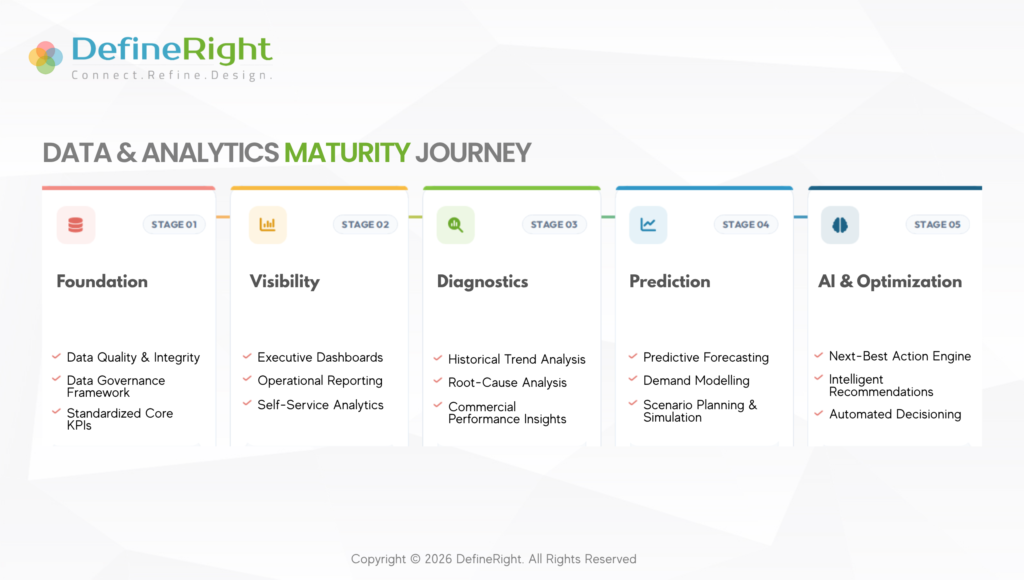
Organizations that mature through these stages generally realize greater adoption and more sustainable business outcomes than those attempting to deploy AI immediately.
How DefineRight Helps
DefineRight helps commercial organizations build the operational foundation required for successful analytics and AI initiatives. Our capabilities include:
- Commercial data strategy and roadmap development
- Business-led KPI definition workshops
- Data governance and operating model design
- Data landscape and dependency assessments
- Reporting framework standardization
- Commercial analytics and executive dashboards
- Business requirements and stakeholder alignment
- Data foundation and governance initiatives
Rather than beginning with technology selection, we work with business stakeholders to define the decisions they need to make, the information required to support those decisions, and the operating model necessary to sustain trusted analytics.
This execution-first approach reflects DefineRight’s philosophy: helping clients operationalize strategy, not simply recommend it.
Final Thoughts
AI has enormous potential to improve commercial performance across life sciences organizations. However, technology alone cannot compensate for fragmented data, inconsistent governance or unclear business priorities. Organizations that first establish a robust commercial data strategy create the foundation for reliable analytics, trusted decision-making and scalable AI adoption.